Categories
New Blog
What are the differences between Single-port SPD and two-port SPD?
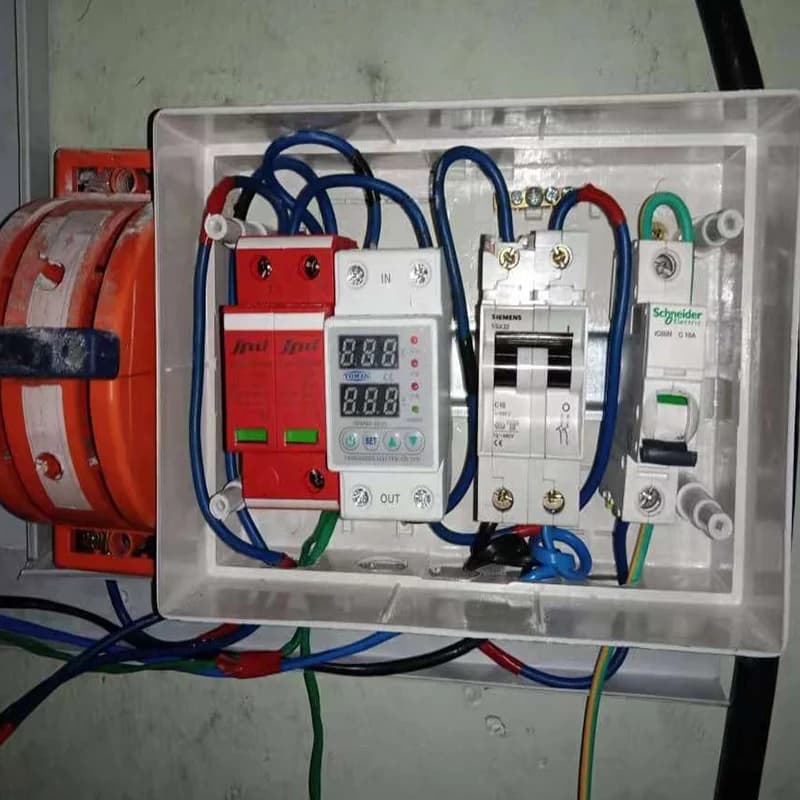
January 22 , 2026The distinction between single-port and two-port surge protective devices (SPDs) is essentially a professional classification based on their circuit topology and connection method within the circuit. A single-port SPD exhibits a parallel connection structure in its electrical configuration, with all its external terminals directly connected in parallel to the protected power or signal lines. The internal protective components of the SPD (such as metal oxide varistors (MOVs) or gas discharge tubes (GDTs)) are connected between the line conductors (L1/L2/L3, N) and the protective earth conductor (PE). Its working principle relies on the step change in its impedance characteristics: under normal operation, it exhibits high impedance, having almost no effect on the system; when subjected to surge overvoltage, its impedance instantly becomes extremely low, forming a discharge path and bypassing the huge transient energy to the ground. The performance of this structure is largely affected by the additional inductance generated by the length of its connecting wires. This inductance causes an additional voltage drop during discharge (U = L*di/dt), thereby increasing the residual voltage, thus requiring extremely strict installation procedures.
Two-port SPDs utilize a series configuration, featuring electrically isolated input and output terminal blocks, forcing the protected line (power or signal) to pass through the SPD in series. Internally, they not only contain core components for energy dissipation but also typically integrate filtering or decoupling networks composed of inductors, capacitors, etc. Their protection mechanism is twofold: firstly, they can dissipate the main surge current like a single-port SPD; secondly, their internal filtering circuit effectively clamps, shapes, and filters the voltage waveform passing through the SPD, thus more thoroughly suppressing ringing waves and various residual voltage spikes, providing a cleaner voltage to the downstream equipment. Due to their series characteristic, the voltage drop generated on the input connecting wires due to surge current is not transmitted to the output terminal, significantly reducing their dependence on installation wiring and resulting in superior and more stable protection performance.
This distinction is crucial in engineering applications. Single-port SPDs, due to their high surge current capacity and cost-effectiveness, are often used for primary protection in power systems (such as the main distribution room of a building). Two-port SPDs, on the other hand, with their superior residual voltage suppression and filtering capabilities, are more suitable for fine-grained protection levels requiring high power quality (such as critical information equipment rooms and medical imaging equipment front ends), as well as almost all signal line protection scenarios. In signal lines, the two-port structure is the absolute mainstream, not only due to the need for surge discharge but also to meet stringent technical requirements such as impedance matching, minimum insertion loss, and maintaining signal integrity during signal transmission.
Jinli Electric WeChat

Address :No. 97-2 Yonghe Road, High-tech Zone, Hefei, Anhui, China
Tel : 0086-0551-65307363
E-mail : jinlispd@ahjinli.com
E-mail : lynn@ahjinli.com
Whatsapp/Wechat : 15209885162