Categories
New Blog
The difference between 3P+N structure and 4P
January 30 , 2024Some lightning protector manufacturers on the market name 4P products as 3PN. 3P+N and 4P circuit breakers are also four-level circuit breakers (consisting of four pairs of input/output terminals). Their difference lies in the zero (N) line terminal. superior.
Among them, some of the 3P+N terminals are straight-through and cannot be disconnected, and some can be disconnected, but the original parts are not protected. Those without protective components may be imported products. Before the 1990s, the direct connection was not disconnected. When wiring, you must pay attention to distinguish the phase line and the zero (N) line, especially for leakage protection circuit breakers, zero (N) ) wire must be accurately connected to this terminal.
The material used for the fourth pole of 3P+N is a switch-type material such as a discharge tube or gap. It is a non-voltage-limiting material. According to standard requirements, it is not suitable to use SCB as backup protection.
The N-phase material of the 4P lightning protector is a varistor, which is a voltage-limiting material. During actual use, short circuits will occur and leakage current will occur. Therefore, the surge protector with a 4P structure needs to be equipped with 4P backup protection. protection device. The SPD with a true 3P+N structure only needs to be equipped with a 3P backup protector.
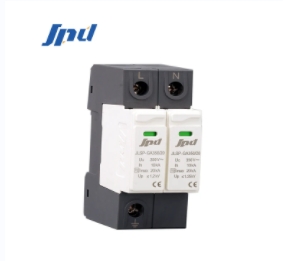
When comparing 3p+n vs 4p configurations, many engineers and installers often seek clarity. While both are used in three-phase power systems, their internal protection logic is fundamentally different. In a standard 4P SPD, all four poles (three phases and one neutral) utilize the same voltage-limiting components, meaning the neutral wire is treated and protected just like the phase wires.
Conversely, an spd 3p+n configuration (the true 3+1 structure) handles the neutral differently. While the three phase lines are protected by varistors directed to the neutral line, the neutral line itself connects to the ground via a gas discharge tube (GDT). This structural difference completely changes how leakage currents are managed during daily operation.
Understanding the 4p vs 3p+n debate is essential for system safety. Your selection should always be based on the grounding system of your specific electrical grid:
Whether you are dealing with a standard 4P setup or need a specific 3P+N solution to prevent RCD issues, selecting the right device structure ensures both safety and continuous operational stability.
Jinli always provides customers with high-quality, reliable products to achieve long-term and stable growth of the company.
We have a variety of surge protector models for you to choose from, whether graphite gap or varistor. There is always a suitable SPD to meet your requirements.Jinli Electric WeChat

Address :No. 97-2 Yonghe Road, High-tech Zone, Hefei, Anhui, China
Tel : 0086-0551-65307363
E-mail : jinlispd@ahjinli.com
E-mail : lynn@ahjinli.com
Whatsapp/Wechat : 15209885162